
The West Ward councilwoman has no ceiling in sight
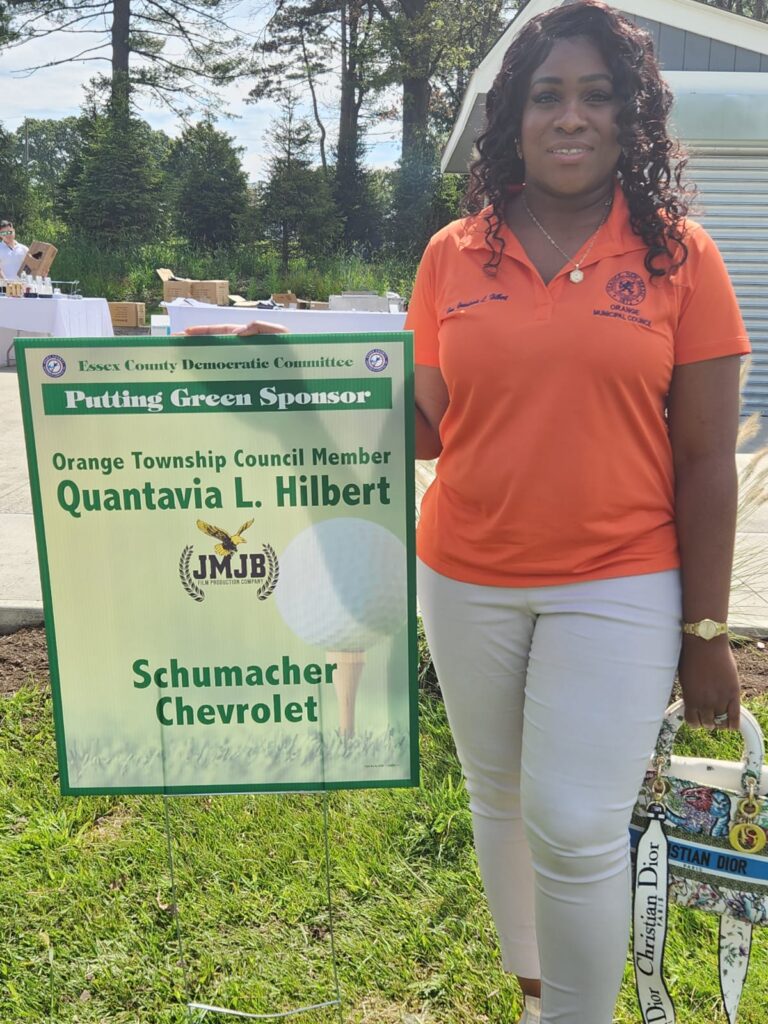
Councilwoman Quantavia Hilbert of Orange, N.J., has no opponent on the ballot May 12th. Some may see this and say the race is obviously over. For Hilbert, it’s a starting point.
“This isn’t so much about campaigning,” she said. “It’s more of a reintroduction.”
Long before she called Orange home, she was already building. She is a wife, a stepmother, a businesswoman, a film producer, and a woman who is still, by her own account, becoming.
“The quantity you see now is still a work in progress,” she said.
From Newport News to Orange, N.J.
Hilbert was born in Newport News, Va., the oldest of four children. Her father served in the Navy. Her mother worked for Bell Atlantic — now Verizon — for more than 15 years, then kept going. She eventually earned a doctorate. Hilbert watched that journey unfold from childhood through her first term on the council.
“My mother has eight degrees,” she said. “She’s my superhero.”
After her family relocated to New York, Hilbert attended Cathedral High School in Manhattan on a full scholarship — an all-girls Catholic institution where she learned, as she put it, how to carry herself in a room with integrity, responsibility, and kindness. Post-9/11, the family moved again, this time to New Jersey. Hilbert has called Orange home for more than two decades.
At the University of Hartford in Connecticut, she double-tracked — health sciences as her major, management as her minor — because she already knew she wanted to own and expand a business, not just run one. The goal was never to stop at becoming a doctor. It was to build something that could grow beyond a single office or community.
Her professors were not impressed.
“A lot of my professors were like, ‘Oh, you behave as if you had something to prove,'” she recalled. “‘Why are you taking management courses? Just take the sciences.'”
She kept taking the management courses.
The irony is that the people who questioned her instincts were working inside the same broken model she was trying to solve. Doctors, she noted, spend years in school, take on six-figure debt, pay for licensing and malpractice insurance, and still end up underpaid and grant-dependent. Now, a generation later, those same professionals are pivoting — building content, chasing marketing deals, trying to figure out how to own something.


She figured that out at 20.
“When I enrolled, I already knew my angle was going to be in business for myself,” she said.
Knowing the angle and trusting it are two different things. A car accident ended her physical therapy track. She graduated with a health science degree instead, took a job dispatching at AAA, cross-trained across multiple departments, and became — by her own account — the first graduate in her cohort to move into management and training. The long way was still forward.
What haunted her was not the accident or the job change. It was the moment she went to the people closest to her — aunts, uncles, cousins still down south — with a vision for a franchise, a business, something. She needed partners. She got indifference.
“Why don’t we do a franchise?” she remembered asking them. “And they said, ‘No, no, we don’t have time for that.'”
She thought she needed approval before she could move. “I was trying to convince them to take a chance on me,” she said, “when I should have took a chance on me.”
That’s a lesson most visionaries learn too late, in rooms full of people who were never going to see what they saw anyway. Hilbert did not have a mentor pulling her forward in those years. She had foresight and self-doubt running side by side, and the self-doubt was louder.
“What bothered me when I was in college was not only did I have this foresight, this vision,” she said. “They immediately shut it down. ‘We’ve never seen that.’ Yeah, you’ve never seen it because God didn’t give you the vision. He gave it to me. He gave it to me to execute.”
She was not talking to her professors when she said it. She was talking about every room, every table, every conversation where someone told her to scale it back.
Building in the Trenches
Before the council seat, Hilbert was an entrepreneur grinding through the reality that gets skipped on business content. She and her husband, filmmaker Jean Michel Jean-Baptiste, launched a trucking company during COVID-19, leveraging her background in healthcare management and emergency dispatch alongside his CDL and route knowledge.
The first truck broke down two months in.
“Being an entrepreneur is not for the weak,” she said. “You think you’re leaving your 9 to 5 to be comfortable? It takes years.”
They rebuilt. They expanded the fleet. They hired drivers from their community — men trying to feed their families, young people who found an income in trucking instead of a college track. The money they made went back into the neighborhoods it came from.
But the harder lesson came from a partnership that went sideways. A third partner, by her account, was more focused on looking like a boss than being one — over-promising, underperforming, spending before the foundation was set. Trust broke.
“It matters who you go into business with,” she said. “Not just because they’re your friends, but what are they bringing to the business to help you strategize and plan for the long game.”
They shut that company down. Started over. The second version was cleaner.

The Film, the Family, the Full Circle
Her husband’s production company, JMJB Film, was already operating when they met. Jean Michel Jean-Baptiste — the JM and JB in the name — had been building the catalog for years. Commercials. Political marketing. Weddings. All of it in two languages, English and Haitian Creole.
Hilbert walked up to him at a networking event and opened with business — she had a travel company at the time and was looking for sponsors. He told her he had a company too. She asked what kind.
“Show me some of your stuff,” she told him.
Hilbert went through the catalog with her management eye — not as a fan, but as someone who could see what was missing between what existed and what was possible. When she was done, she made him a promise.
“If you give me a chance,” she told him, “I’m gonna get you to Hollywood.”
He heard her. Then he pivoted.
“Before we get to Hollywood,” he said, “can I get you down the aisle?”
She shut it down immediately. Business or pleasure, she told him. Pick one.
He picked marriage.
“Just marry me,” she recalled him saying. “We’ll talk business later.”
She laughed telling it. But she means it.
Hilbert kept her word. Two years ago, they walked a film into the TCL Chinese Theatre in Los Angeles for the Silicon Valley Film Festival. It won best editing. Jean-Baptiste wanted more — best director, best actor, something with more weight. She reeled him back in.
“You got to take the little wins,” she told him.
He had a point, she admitted. But so did she. Taking the stage at the Chinese Theatre with a film made in New Jersey is not a small win. It is a full circle — the kind that only closes when someone holds the vision long enough for the world to catch up.
“I told my husband when I met you, you were a film director,” she said. “That’s who I signed up for. That’s our dream.”
Asked what she is most proud of across all of it — the trucking company, the film festival, the council seat, the mayor’s race — she did not name an award or a contract or a vote count.
“I am most proud of my relationship with my husband,” she said. “He’s my friend. He’s my business partner. He’s my counselor.”
On Mother’s Day weekend, that answer carries weight that a résumé cannot. Hilbert is a stepmother who speaks about partnership the way most people talk about strategy — with precision, with earned authority, and without sentiment that outpaces substance.
“To find a relationship and to do the work to make it last,” she said, “that is a major accomplishment.”
Politics Came Through Art
Hilbert did not plan to run for office. The entry point was a café.
She and her husband were holding casting calls at the Artful Bean, a small spot inside Orange’s Valley Arts District. The district was a pocket of creative infrastructure in a city that has not always made room for it — and the Artful Bean was the kind of place where people actually talked to each other. It no longer exists.
But while it did, it introduced her to the people who would change her trajectory. She met the town historian there. She met locals who had been watching their city from the inside for years. They started telling her what was happening in Orange — the development deals, the displacement, the decisions being made in rooms most residents never entered.
“Instead of complaining about it,” she said, “why don’t we inquire, ask questions, show up to meetings, voice our opinions?”
So she showed up. She ran for an at-large council seat in 2020 and lost. She came back in 2022, ran for her ward, and won — becoming the first woman of color to represent that district. The seat was not handed to her. She funded her own campaign, drawing from her business rather than from developers or political networks whose endorsements come with terms attached. The council seat is not the ceiling. She has made clear she intends to become the first Black woman to serve as mayor of Orange. The 2024 race was round one.
“You want to be careful with who you take money from,” she said. “Because you have the developers, the certain lobbyists — and taking money from people means you’re also saying you endorse what they’ve got going on.”
She kept her vote clean. Sometimes that meant standing alone.
In 2024, she ran for mayor but came up short. The following week, she was at the council meeting.
“Everything I did,” she said, “you could see everybody eating it up. Everybody was copying off of me.”
She does not say that with bitterness. She says it the way a woman talks when she has made peace with being the blueprint — when she understands that imitation is confirmation.
She kept building. She kept showing up.
On the issues, Hilbert does not soften the language.
“I’m fighting against gentrification,” she said. “I’m fighting against Black businesses shutting down. I’m fighting against affordability issues.”
When new development proposals came before the council with no affordable units attached, she voted against them. Her colleagues pushed back. The administration pushed back. She absorbed it.
Running unopposed this cycle does not mean the fight is over. For Hilbert, uncontested just means more bandwidth to stay on offense.


What She’d Tell Herself at 22
Hilbert is, by her own description, still running laps.
She ran her first race at 35. She was the youngest person at most of the tables she sat at. Her colleagues’ children were her age. She advocated for herself and her vision anyway.
The advice she would give her younger self — 22, at a crossroads, waiting for someone to believe in her before she believed in herself — has nothing to do with strategy or positioning. It is simpler than that.
“Your mind has to be stronger than your emotions,” she said. “Because if you get caught up and you stay down for too long, you’re not just missing the opportunity — you’re blocking the opportunities that are still rolling.”
She went back to school. She is pursuing her master’s degree while holding a council seat, running a campaign, producing films with her husband, and building community one door at a time. She knocked on doors the night before this conversation. She will knock on more before Tuesday.
“Action will always manifest the next step,” she said. “And it will also attract the right people to be on your team, to be in your ear — and it will attract the right opportunities that will awaken more of you.”
Hilbert is not asking Orange to hand her anything. She never has. She is asking residents to show up May 12 the same way she showed up to that council meeting the week after she lost the mayor’s race.
“The end goal is to be happy with who you are, who you become, and how you show up in the world,” she said. “And how you show up in the world can actually motivate the next person.”
Orange’s municipal election is Tuesday, May 12. Polls open at 6 a.m. and close at 8 p.m. Councilwoman Quantavia Hilbert is on the ballot in the West Ward, running unopposed. Showing up still matters. An unopposed candidate with no votes cast is not a mandate — it is a missed conversation.
Show up on May 12.