








A nostalgic celebration at Newark Symphony Hall proved what textbooks left out—Newark and Harlem’s creative movements were never separate. They were siblings.
There were two Newarks in the 1920s. One had Newark Symphony Hall, which opened in 1925 but didn’t allow African Americans to perform. The other had “little Harlem”—the stretch of Spruce, Broome and West Kinney Streets in the Old Third Ward, where Black musicians and entertainers built their own venues and didn’t wait for permission to create. For fifteen years, the Renaissance thrived in the streets while the hall stayed closed to Black performers. In 1940, American contralto Marian Anderson became the first to break that barrier. Her performance was historic, but it wasn’t the spark. It was the institution finally acknowledging what the community had built.

On Oct. 10, 2025, as the hall carries on tradition with Sugar Hill to Sugar Hill, the community showed up in 1920’s dress to celebrate what textbooks never quite captured—that Newark’s creative legacy runs parallel to, and in unison with Harlem’s Renaissance.
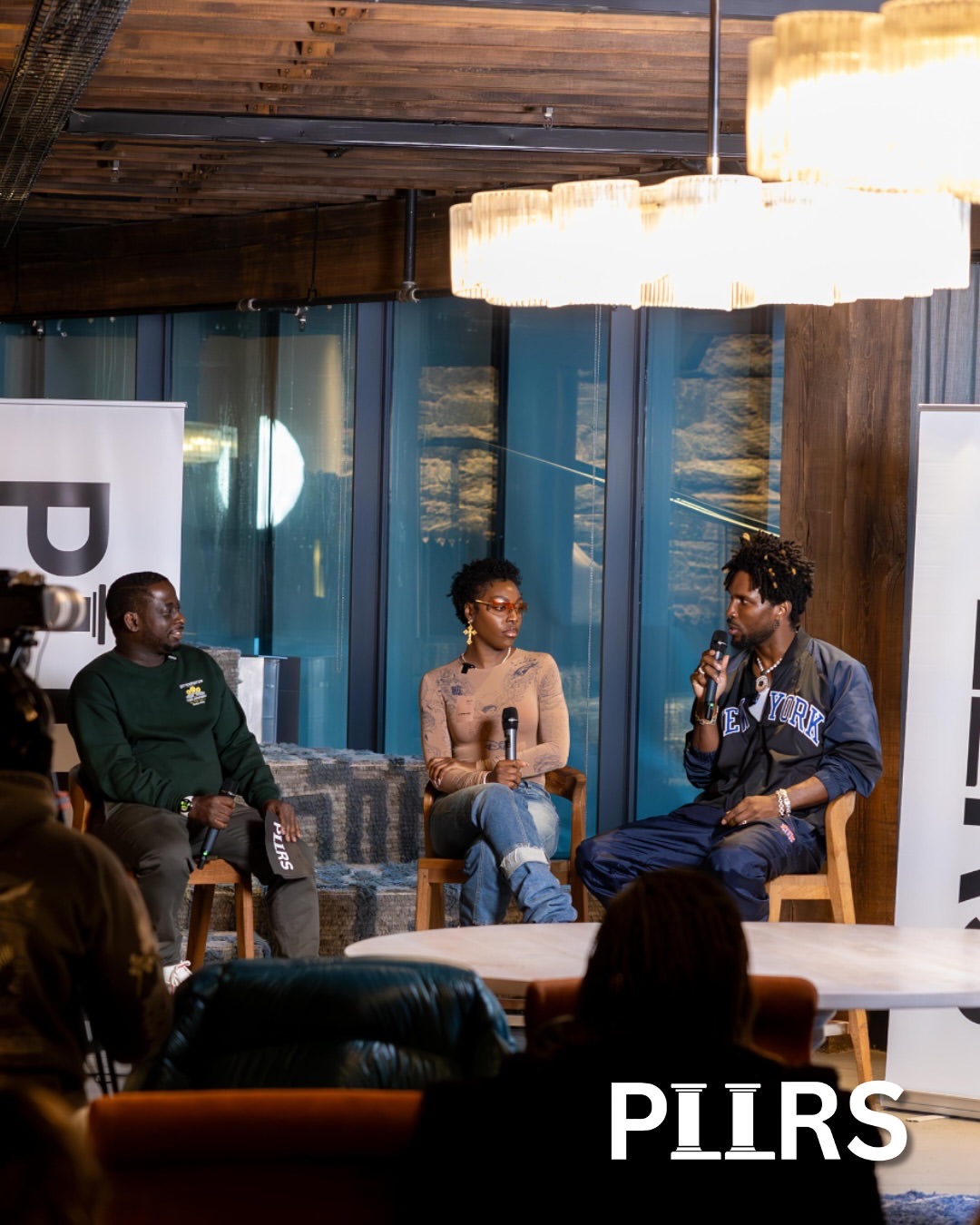
Made possible by Harlem Fine Arts Show, AARP, Newark Symphony Hall and I Am D Muse, Sugar Hill to Sugar Hill was a night to remember. An art and jazz exhibition created and produced by Dontae Muse of The B.A.G. Tour alongside Zeale Cre8tive Studio’s Zakiyyah Williams and art collector and educator Adrielle Turner, brought together visual art, live music, spoken word and a panel moderated by Tiffany Salas of Chiffani Brands Unlimited that traced the historical and cultural threads binding the two cities. The night became both a history lesson and a homecoming.
The Stage That Never Stopped

“Young artists can’t go anywhere if they don’t understand where they came from,” said Talia Young, president and CEO of Newark Symphony Hall. “Right now, you have literally a room of generations. The difference is the technology, the exposure and access, but the artistry and expression is the same at the core.”
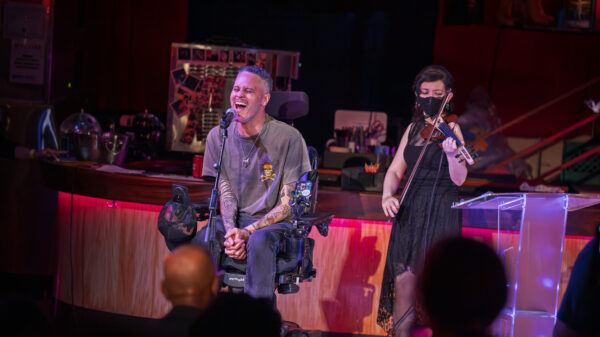
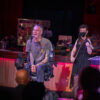
Newark Symphony Hall hosted legends and created the conditions for them to thrive. On this night, the same space that held Count Basie’s orchestra held the soulful Sunnie Allen with Sunday Dinner, a jazz collective that grew up playing the standards before they understood the weight.

“We grew up playing certain jazz standards. Like, before we even knew it was our legacy, we were playing it.” said bandleader Brandon Edwards. The band that makes music feel like family backed Sunnie Allen with her version of Billie Holiday. Allen embodied the kind of grief and grace that made Lady Day unforgettable.
Positive performed a rendition of Zora Neale Hurston as if the Ancestor was on stage with her. The poet studied Hurston’s cadence and defiance, and that energy filled the room—a reminder that the writers and thinkers of the Renaissance were the blueprint.

“I wanted to bring her to life as best as possible,” Positive said. “Tonight, at Sugar Hill to Sugar Hill, we’re honoring the waymakers, we’re spotlighting the creatives that dared to be creative in a time that they really weren’t privileged to be that.”
The Ritual of Memory
Host Petey McGee guided the evening with the kind of ease that made the historic venue feel like a family gathering. The dress code was optional but attendees arrived in feathered headbands, bold colors and statement silhouettes. The aesthetic was about stepping into the visual language of an era where Black creativity reshaped American culture.

Actor Khalil Kain, who starred in “Juice” alongside Tupac, showed up in vintage perfection. He said, “This is the perfect opportunity to break this one out. You can’t do the prominent pinstripes all the time.” Some attendees went full flapper. Others channeled Langston Hughes. The commitment to the era’s style was respect disguised as fashion.
His tone shifted when he spoke about community. “Now, more than ever, our community needs to stick together and understand that community is the most important thing in 2025.” Before leaving, Kain reminded us that the African diaspora extends beyond American borders. “Ghana’s real nice,” he said with a smile.
The Art as Argument

Co-curator Adrielle Turner presented work by Marc Andre, Steve Eloiseau, Dapo Da Vinci, Daquane Cherry and Cole the Renaissance. Artists have continued working through the decades—evolving, refining, building. The Renaissance never stopped.
Dapo Da Vinci, a fine artist from Lagos, Nigeria, now based in Brooklyn, came to Newark to learn its history. “For me, the art is a bullet for freedom and medicine for healing,” he said. “Just like Fela Kuti, I believe the art is for liberation.” The Renaissance stretched across oceans, across generations.

Eric Roberson, the Grammy-nominated soul artist, framed his role differently. “I’m what I call a proud uncle now,” he said. “Proud father is guaranteed. Proud uncle means reaching out and making sure the community is straight. Make sure the youngins are playing zone defense. Make sure all of them are coming up to recognize: Hey, look how we take care of the sisters. Look how we take care of the elders.”
That generational responsibility shaped the entire night. The elders in the room—many of whom attended thanks to AARP’s support–understood they were the living embodiment of the Renaissance.

The ethnographic panel, moderated by Tiffany Salas, featured Richard E. Pelzer II of Harlem Fine Arts, visual artists Levi Robinson and Bernard Jackson, and historian Reginald Blanding Jr. Their task was simple: trace the historical connection between Harlem’s Sugar Hill and Newark’s creative movement.
What emerged was clarity. The two cities were siblings. The same artists who played the Apollo played Newark Symphony Hall. The same energy that fueled Harlem’s Renaissance fueled Newark’s clubs, its visual art scene and literary circles.

The panel made clear that the artists who built Harlem’s legacy didn’t stay in one place. They moved between cities, carrying the Renaissance with them. “The audience understood the connection of the sister cities and were honored to be residents of Newark and Harlem,” said curator Dante Muse when asked about feedback from the event.
The Toast
Tracie Franklin, the Liquid Curator of Edmond’s Honor Bourbon, opened the evening with a toast. The bourbon is named after Edmund Albius, a young botanist from the island of Réunion who cracked the code of vanilla pollination in 1841.
“We’ve got all of these ties to history, to France, to Réunion, to Madagascar, and it’s all in one bottle,” Franklin said. “I’m just really excited to be able to share the legacy.”

“The core of the Renaissance is still happening. That’s why Sugar Hill to Sugar Hill is so important—the same thing that’s happening in Harlem is happening in Newark. I think telling that story, reminding ourselves that it will always be that circular paradigm, but we have to preserve it,” declared Talia Young.

Preservation is active, intentional and funded. And for the next 100 years, Newark Symphony Hall will continue to be the stage that pushes the culture forward.
Sugar Hill to Sugar Hill honored the past without being stuck there—an acknowledgment that what we thought was history is still present. Still powerful. Still ours.
This is the first story in Renaissance Now, a West Ward Beans editorial series exploring how Black creative economies preserve legacy and build forward. Subscribe to our newsletter, EXPRESSO, to get the next installment delivered to your inbox.
Got a story about your city’s hidden Renaissance? Send it to [info@westwardbeans.com]. We’re listening.
ADDITIONAL CALL TO ACTION—> WHAT IS DONTAE’S NEXT EVENT?