


We Have the Right to Remain Silent, But It’ll Cost You
I walked into the Black Men Vote summit thinking I understood civic engagement. I left understanding that I had been avoiding politics my entire adult life.
I vote, sometimes. But the deliberate, uncomfortable, confrontational work of political engagement? The kind that makes people nervous when you walk into a room? I had convinced myself that staying “neutral” was the smart play. That I could build a media platform without picking sides. That journalism meant observing but not fully participating.
Mayor Ras Baraka dismantled that logic in under sixty seconds.
“The only issue I have is when we say we don’t want to be political,” Baraka told a room of nearly 100 Black men(and a handful of women) gathered at Brivado Cigars in Orange. “Everything is politics. Everything happening to you and about you and around you is because somebody made a decision. A political decision. And because we refuse to make the decisions, we’re in the situation that we’re in.”
He continued.
“You don’t see us at council meetings. You don’t see us at commissioner meetings. You don’t see us at PTA meetings, because we’re busy making money. We’re trying to take care of our families, make ourselves relevant and alive and well in a system and a country that’s been trying to kill us one way or another, decade after decade.”

The room went quiet. Not the polite quiet of agreement. The uncomfortable quiet of recognition.
The Weight of 0.03 Percent
Before Baraka spoke, Robert L. Johnson—partner at FBT Gibbons—had already set the table with numbers that should have made every man in that room angry.
“The data shows that Black people—Black people in particular—we’re fifth on the minority list,” Johnson said. “Every other minority group is doing better than us in state procurement dollars.”
Fifth. Out of five. Not fifth out of fifty. Fifth out of five minority categories tracked by New Jersey’s own disparity study.
“If you’re going to give someone 97 percent of your vote, you can’t have 0.03 percent return on your investment,” Johnson continued. “I value the Black vote a bit more than that.” NBC News exit polls showed Sherrill receiving 94% of the Black vote against Republican Jack Ciattarelli’s 5%.
The math is devastating when you slow down long enough to see it. New Jersey commissioned a $307,000 disparity study that confirmed what Black business owners already knew: the state egregiously discriminates against minority-owned businesses in procurement. The study found that 10 percent of Black-owned businesses that bid on state contracts had the capability to fulfill them. They were qualified—and still excluded.
“Banks aren’t lending to us. Angel investments aren’t looking at us. Venture capital isn’t lending to Black-owned businesses,” Johnson explained. “Most businesses get some type of working line of credit that sustains them until they get paid. We don’t get that. That’s an almost impossible hurdle.”

The remedy exists. New York State has legislation that survived legal challenge—even in this political climate—because it’s narrowly tailored to address documented discrimination. New Jersey, right across the water, can’t seem to copy the homework.
“It wasn’t Republicans blocking it,” Johnson said. “A remedy was presented. Served on a platter. Pass it.”
Miranda Rights for Black Voters
Former Paterson Mayor Jeff Jones offered a framework I haven’t been able to shake.
“I don’t know that we are less inclined to vote as much as we’ve lost our purpose and our reason to vote successively,” Jones said. He teaches Black politics at St. Peter’s University. He’s thought about this longer than most.
Then he introduced what he called “the Miranda principle.” The Miranda warning—rooted in the Fifth Amendment right against self-incrimination—informs suspects they have the right to remain silent. Jones flipped it.
“You have the right to remain silent,” Jones said. “You have the right to allow your son to go to school and not check on his work. That is your right. And if you choose to accept that right, the conditions and circumstances that befall him—such as a lack of education, lack of opportunity—that was your right.”
The room understood exactly what he meant.

“We can have all these rights, but we don’t exercise them. And if we don’t exercise them with purpose and intent, then the outcome is what it’s going to be.”
Jones pointed to the phones in our pockets. Devices we charge religiously, upgrade constantly, protect with cases and screen covers. “We have not turned that into a vessel to get people regularly engaged about the issues that face us. How regular do you call somebody other than when you need them? How regular do we post information? Or do we only do it when that flag or that issue comes up?”
The moment for change doesn’t arrive because change needs to happen, Jones argued. It comes because we make engagement a regularity in our lifestyle. Anything else is failure.
The Home Before the Building
Charles Way—former NFL fullback for the New York Giants—brought it back to fundamentals.
“I come from inner-city Philadelphia,” Way said. “I didn’t know I lived in a low-income area. I didn’t know until I got to the NFL that where I lived was below the poverty line. And the only reason that happened is because of my parents.”
Way’s message was direct: before we talk about putting names on buildings, we need to build our families.
“You don’t need money to start generational wealth. Put a dollar in your grandkid’s savings so he can go to college. If he doesn’t want to go to college, let him get a trade. You make more money coming out with a trade anyway. And AI can’t take that job.”
He challenged the room to stop just talking. “Let’s be disruptors. But you gotta give me a reason to disrupt. I need somebody qualified to manage my money if I’m a professional football player.”
Way pointed to Calvin Souder, an attorney at Hamilton Clarke who was in the room. “I wasn’t introduced to competent Black financial advisors until I helped put this event together. That’s on my Rolodex now. But it starts in the home. Where’s your son? Where’s your daughter? We need more. Because we’re all fathers. Let’s bring them.”

The Prayer and The Charge
Rev. Semaj Vanzandt, president of the General Baptist Convention of New Jersey—an organization representing nearly 250 churches and over 300,000 people across all 21 counties—offered the invocation. But his words before the prayer carried their own weight.
“I don’t think that we just participate in politics and political affairs,” VanZandt said. “I believe that we really should reshape it. Voting for us is not just a responsibility—it is stewardship.”
Newark Council President Lawrence Crump echoed the frustration that brought many men into the room.
“The first meeting I went to for Black Men Vote, Mike asked why I was there,” Crump recalled. “I said, because I’m tired of voting for the lesser of two evils. That’s what we’ve always ended up doing. We don’t end up getting the person we want. We get the person we settle for.”
Crump’s charge: keep their feet to the fire. “What’s going to happen is they’re going to pick people off. Give them a little something here, a little something there, so you forget the big picture.”
Lieutenant Governor Tahesha Way made a surprise appearance, reminding the room of Thomas Mundy Peterson—the first African American man to cast a ballot in the United States, from Perth Amboy, New Jersey. “What you are doing here this evening is carrying on his legacy,” she said.
The Question That Won’t Leave
Mayor Baraka’s closing brought the room to its feet. But it was Joshua Baker’s question afterward that stuck with me.
“We’re meeting here as a group, collectively,” Baker said. “But when we go back to our individual spaces, how do we get back in touch with one another? How do we bring together all of our creative ability to support one another? And how do we collectively come together to challenge the system?”
Baker was identifying the gap between assembly and action.
“The system is dictated by lobbyists. They’re writing the laws, putting the money behind people, silencing certain people. We’re powerful, but we’re independent. How do we come together and get that one single voice on particular matters?”
He answered his own question: “We need a lobby group. AIPAC is a prime example. The reason why the legal changes that were made happened was because the NAACP was a legitimate entity that could activate people. Right now, we need that entity.”
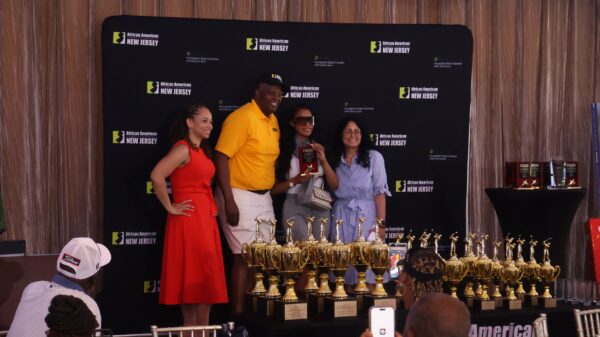
Dr. John Harmon Sr., founder and CEO of the African American Chamber of Commerce of New Jersey, heard the call. He committed to sponsoring four more Black Men Vote events in 2026.
Four events. Four opportunities to turn assembly into infrastructure.

What Happens Next
I walked into that room a journalist. I walked out understanding that observation without participation is a luxury Black men can no longer afford.
“The Black Men Vote event was about creating space for honest, necessary conversations that too often get pushed to the margins,” said Dr. Brian D. Agnew, Founder and CEO of Brivado Cigars. “Serving as a panel moderator was both a responsibility and an honor—bringing together leaders, entrepreneurs, and elected officials to confront the issues shaping our community and to remind Black men that their voices, their perspectives, and their votes truly matter.”
The question isn’t whether we engage. The question is whether we engage with purpose, with coordination, and with the understanding that our silence has consequences. Baraka was right. Everything is politics.
Baker asked how we stay connected. This is one answer.
West Ward Cafe will be covering every Black Men Vote event in 2026. Sign up for our newsletter or share with someone who should be the first to know when Dr. John Harmon’s sponsored events are scheduled. The conversation continues as long as we keep showing up.
And we’re just getting started.