







How one licensed pathologist turned free video into a workaround for families stuck on waiting lists.
My son James III spent 27 days in the NICU. He was past his first birthday and still wasn’t talking. No babbling toward words, no reaching for them. My wife and I weren’t ready to put a doctor on it and we weren’t panicking. We were looking.
So we went to YouTube.
What I needed was specific. I needed a Black woman teaching my children, because whoever stands in front of my kids is who they absorb. We found Ms. Zoey. We ran her episodes at home and started using the way she talks to children. James started talking.
I went looking for representation and picked up a licensed clinician in the bargain.
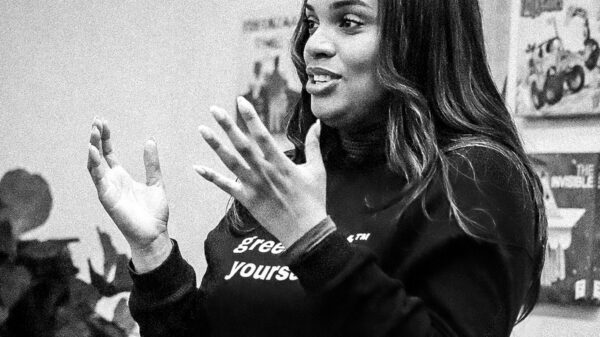
Ms. Zoey is a licensed speech-language pathologist who spent more than eight years walking into other people’s living rooms as an early intervention provider in New York, now based in New Jersey. Her YouTube channel is free; her Skool membership runs $39 a month. She shot her first episodes in a closet, on the laptop she still uses, because it was the one room her two small children could not get into and it had a white wall.
On a video call with her, with my son in the next room, I learned where all of it started.
PURPOSE
The origin is a hospital stay. She was 12 when her sister was born at 25 weeks, a pound and a half, and stayed in the hospital six months. Doctors told the family to expect speech and language deficits. They were right. Her sister is autistic.
Then early intervention showed up at the family’s Brooklyn apartment. The therapists came with bags of toys, got down on the floor of a small apartment, and put the baby on a ball, and a 12-year-old Ms. Zoey sat there watching grown adults get paid to play.
“I saw the therapists come in with their toys, and I was like, this is your job,” she said. “And as a 12-year-old, I’m looking at this and I’m thinking, this is amazing. This is what I need to do.”
That was the career decision. She went to school for it with no Plan B in sight. She graduated into early intervention, the birth-to-3 window. Thirty minutes per child, in somebody else’s living room, then drive to the next one.
Her first son arrived in 2020. Maternity leave handed her the first uninterrupted stretch of thinking time she’d had since graduation, and what surfaced was an indictment of her own profession.
“There’s a lot of professionals that like speak out of turn in early intervention,” she said. “They traumatize parents with their words. I’ve heard a lot of parents say, like, oh, the speech therapist said my baby will never talk. Like, what? Why are you telling parents this?”
So she built a course and needed parents to trust it before paying. The answer was free video. Her first instinct was the talking-head version, glasses on, parents-here-is-what-you-do. She scrapped it. “That’s just not me,” she said. “That’s boring to me.”
What worked was the thing she already did for a living.
“I am rolling around, I am jumping like a frog, like whatever’s gonna make that baby talk, I am doing it, and it works, because babies want you to be excited, they want you to be alive,” she said. “They know that you don’t care. They can tell.”
She was mid-session, on the floor, with the mother and father watching from the couch. The brand exists because of what the father said next.
“He would watch you if you were a show,” he told her. “You’re just so animated.”
She has not stopped acting on that sentence since.
“It just hit me right then,” she said. “I was like, that’s what my course needs. It needs me to do it.”
It got confirmed a second time when she was pregnant with her second child and moved to virtual sessions, running toddlers over a laptop.
“I was basically doing Ms. Zoey but live,” she said. “I would have like six babies a day, and I’m holding each and every one of their attention. I’m like, wow, this is actually working.”

THE MISSION
The distinction she guards hardest is the one most parents miss. The videos are modeling. They are not therapy, and she will correct you on it.
“In therapy, there’s a diagnosis,” she said. “Every child is different.”
The videos do something narrower and repeatable. If a child has no words, she models animal sounds. If a child has words but no sentences, she stretches them. A child says “milk.” She hands back “I want milk.”
Then the burden goes to the couch. She has watched nonverbal autistic children finish two years of services in full sentences, and she says the variable is never the therapist.
“The children who make the most progress, that parent is highly involved,” she said. “They’re asking questions. What did you do here? How do I model this during eating time?”
A therapist gets 30 minutes, twice a week. The strategy has to leave the session. Dinner table. Bedtime. Cleanup.
Most parents come to her about the screaming before they come to her about the silence. She frames the connection of speech and behavior as observation rather than expertise, because behavior is not what she’s licensed in. But after eight years in clients’ living rooms, she noticed a pattern.
“When a child cannot communicate what they want, could you imagine the frustration when you know what you wanna say, but no one understands you?” she said. “Major tantrums.”
She has a client right now working on a single word.
“His tantrums has decreased 50% since he’s learning how to say no,” she said. “But if you don’t have that simple no, now you’re spiraling, you’re having a whole meltdown, behaviors done, day is over, mom is stressed.”
The other thing she is building, she did not set out to build. Before the first episode existed she was working in schools, running a session with a 5-year-old Black girl. The activity was a lineup of cartoon babies to dress, three shades of brown and one white. The girl picked the white one, which was fine. Ms. Zoey asked why she hadn’t picked a brown baby.
“She said, oh, that baby is ugly, and she was talking about the baby her color,” Ms. Zoey said. “I literally bawled my eyes out. And she’s 5. And I’m like, you feel ugly at 5.”
Mamie and Kenneth Clark ran a version of this with actual dolls in the 1940s, and the Supreme Court cited it in Brown v. Board of Education. Ms. Zoey got it live, on a school computer, from a kindergartner.
“I’m doing this for 2-year-olds and 3-year-olds,” she said. “I’m hoping they look at me and think, I’m brown just like her. I’m beautiful too.”
BUILDING
The gap she is aiming at is structural and mostly money, and it has three layers.
The first layer is the family that never qualifies. Federal law requires every state to run a birth-to-3 program, but each state writes its own delay threshold, so a child who is visibly behind can miss the cutoff and get nothing. The families who do clear it sit in line. Ms. Zoey has watched parents wait six months in New York and New Jersey, two states where she says services are abundant.
The second layer is the money. Home-based early intervention pays fee-for-service, so clinicians who want a predictable check take the hospital job, and the home-visit pool stays shallow even where therapists are plentiful. Ms. Zoey puts private sessions at $50 to $100 for a half-hour. National cost surveys run higher, $65 to $175 for the same 30 minutes. Either number is a wall for a family paying cash.
The third layer is everyone else.
“You’re out of this country, you don’t have U.S. dollars,” she said. “Maybe they don’t have speech therapy at all. We know that there’s children with disabilities out of the country. We know that that exists.”
Her answer to all three is the same answer.
“I cannot fix the whole problem, because it’s a foundational, governmental kind of an issue,” she said. “But that’s why I created the course. I made it super cheap.”
The company is self-funded. She applied for grants early, got denied, and went back to clinical work to pay for the show. In the early days a single episode took her about 24 hours of editing, on top of a full caseload and two children. She does not edit anymore. Asked what she would do with real capital, she did not hedge: a team, a production company, a better editor, marketing.
What the money buys is resolution. She wants 4K and smoother transitions, a picture that holds up on a wall-sized television, with the same white background behind it. She has a phrase for what she is keeping.
“I want to keep true to being a speech therapist, and keep true to having healthy TV,” she said.
Production budgets tend to push the other way, and she has watched it happen to other people. “You get more money, and now everyone is like, let me add this and this, and let’s add the pacing and the lights,” she said. “I don’t need it to be that much.”
Above everything she is protecting the tempo, because the tempo is doing clinical work.
“That’s intentional,” she said. “I’m using my own voice to add the speed so that your baby can pay attention, because I know what pace a 2-year-old is going to pay attention to.”
Speech-language pathologists put a typical 2-year-old’s attention span at three to six minutes per task. Her episodes accelerate and decelerate inside that window on purpose. The songs work the same way, and she picks them on the same grounds.
“Songs number one, it hooks them quicker,” she said. “It gets stuck in the brain, and it’s also really good for their language development.”
She has one episode built around a song called “I Love My Hair.” That is a curriculum decision and an identity decision arriving in the same 90 seconds, which is roughly the whole thesis of the operation.
Asked where it goes from here, she committed to one thing.
“I do see myself being on, like, a big streaming platform, but we’ll see,” she said. “I’ll tell you one thing, I’m not stopping.”
Near the end of the call I asked whether my son could come say hi. James III walked in on a mission. She asked his name and he gave it, then went straight past the small talk to: “I want you to teach me how to ride a motorcycle.”
“OK, but James, I don’t know how to ride a motorcycle,” Ms. Zoey said, smiling. “Can you teach me?”
He told her he didn’t know how either. She asked his favorite color motorcycle. He said blue. She handed it back with the noun attached, a blue motorcycle, which is the exact move she had spent the previous hour describing to me. Then he ran off to whatever little people do with their free time. He had no idea he was talking to the woman who guided us in helping him speak.
He was past his first birthday and he wouldn’t talk. On this call he negotiated motorcycle lessons.
Ms. Zoey’s episodes are free on YouTube at Ms. Zoey Speech Therapy. If your child is under 3, federal law requires your state to run an early intervention program, the evaluation is free, and you can refer your own child without a doctor. Call them the same week you start watching.