


















The composer behind “Migrate” and a chart-topping independent singer bet on one night at the Gramercy Theatre, before they have played a note together.
Jackson A. Waters was scrolling Instagram in search of his next collaborator when a venue’s account posted a singer he had never heard. “I thought it was groovy,” he said.
He was recruiting for Live Room, the series he founded in a Brooklyn loft to put R&B, jazz and pop singers in front of classical players. So he sent a message.
On the other end was a woman who had spent just over a decade building a following independently without a major label or any other label but her own. Simrit, who records and tours as SIMRIT, put four albums at No. 1 on the iTunes World chart between 2015 and 2019 and three into the top 10 of Billboard’s New Age Albums chart, all on her own label, Simrit Kaur Music, LLC. Belinda Carlisle of the Go-Go’s sings on one of her songs. She is careful with her inbox.
“When I got the message, I will be straight up about it,” Simrit said. “I get a lot of weird messages, and some of them are meaningful and real, and some of them aren’t.”
She took it to her manager. “I told my manager, I was like, I don’t know about this, but it sounds really cool,” she said. “So we started checking out the links, and we were like, oh yeah, this is legit.”
The first exchange came in January. By May, a single session had grown into a full concert. “My mind starts to turn, the wheels start to turn, and I’m like, can we get a live album out of this, or at least an EP, can we get a video?,” she said.
On Oct. 18, Waters conducts the 13-piece Live Room Orchestra behind Simrit at the Gramercy Theatre in Manhattan. Promoter CEG Presents bills it as the first time her catalog has been arranged for and performed with an orchestra. Cameras will roll for a live album.
When I spoke with the two of them in late September, they had yet to rehearse in the same room. Simrit lives in Northern California and has heard his arrangements only as recorded mockups. The orchestra’s first rehearsal is scheduled without her. She joins the next day, and the day after that they move into the Gramercy.
“It sounds amazing already, and I haven’t even heard it with a live orchestra yet,” she said.
“It’s in my blood and bones”
When I asked what she draws from the past, Simrit pointed to one song on the program.
“It’s a Greek song that is centuries old,” she said. “It’s a traditional folk song that I grew up hearing … It’s in my blood and bones.”
She was born in Athens, Greece of Cretan and Athenian descent, and raised in South Carolina inside an Orthodox church community of Greek, Egyptian, Ethiopian, Levantine and Armenian families, among others. “I listened to Greek music all the time, Middle Eastern music all the time, North African music all the time,” she said.
The song, she said, was written under occupation. “It carries like the triumph of my ancestors actually, you know that have come through all of that.”

Her great-grandmother, Tula Demetriou, was a Greek singer and actress known for resistance music, according to Simrit’s official biography.
“I literally carry the voice of my female ancestors, my matriarchal bloodline,” Simrit said. “Who were also singers.”
She also sings in Gurmukhi, the script of Sikh scripture, a language she was not born into. She began singing it before she could read it.
“I was like this doesn’t feel right,” she said. “If I’m going to actually carry this language, I need to be in integrity with it, and learn it, and learn to read and write it, and understand it.”
“When we do carry our lineages … we bear a responsibility.”
Onstage, she tries to step aside and let the music lead. “What I try to do, it is to get out of the way … so that I can be a conduit for other people to experience that,” she said. “Something happens when we get lost in the music, and something starts to play us, and that is the highest form of music that I’ve ever experienced.”
When I asked what her audiences experience, she pointed to what they write to her afterwards. “One example was a person that came with severe burns,” she said. “When they were at the concert, they felt no pain.”
Another letter came from a mother who had lost her son a year earlier.
“She got the download of where her son’s remains were, and she called the police the next day,” Simrit said. “They went and they found his remains.”
“That’s the power of music,” she said. “To feel things, to know things that the thinking mind alone just can’t.”
The orchestra will tune to 444 hertz, 4 hertz above the modern 440 standard, the tuning Simrit has played in for her entire career. She ties the tuning to DNA healing and transcendental energy. For the oud in the ensemble, a lute she grew up hearing, she has one standing request. “I want to hear more of the oud in this particular song,” she said she told Waters.
When I asked for the biggest lesson she has picked up along the way, she answered in three words. “Less is more. Less is more with everything in my life,” she said.
It came from producer Paul Mahern, the former Zero Boys frontman who also goes by Mahan Kalpa Singh, back when her bands played every note they could.
“You can play with incredible musicians that all have incredible chops, and can play the phone book,” she said. “He really taught all of us that less is more, and that’s when the music got really good.”
“What will be and what could be”
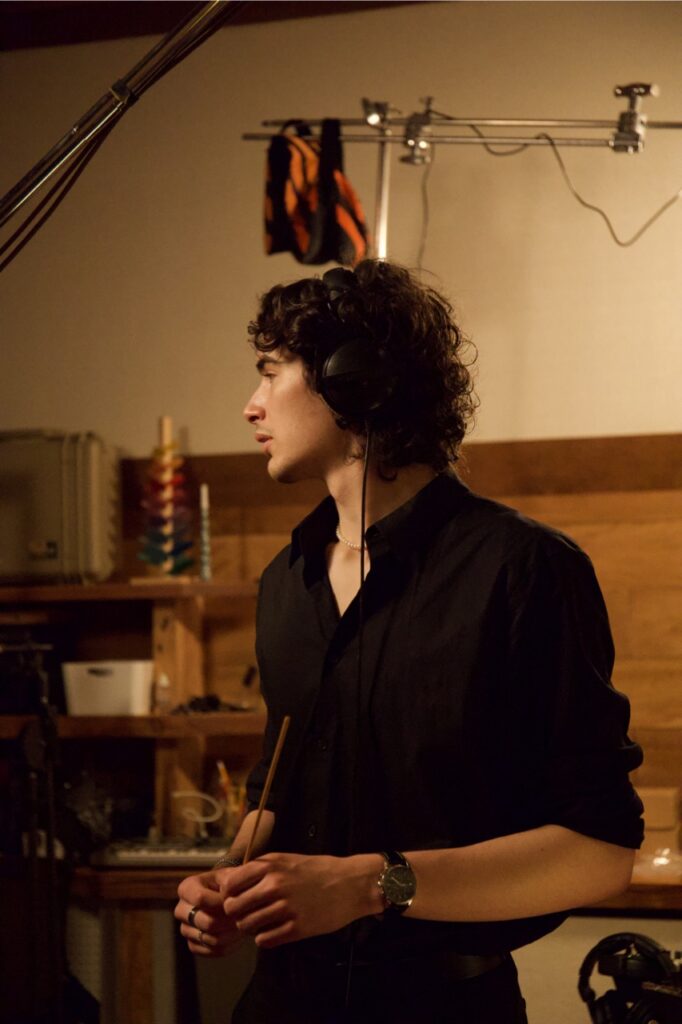
I was at Carnegie Hall in May when “Migrate” premiered. Waters has barely sat still since. In June, the San Francisco Contemporary Music Players gave the world premiere of his “my rage is quiet” at Herbst Theatre. In August, the Cabrillo Festival of Contemporary Music in Santa Cruz, California, performed “Defending Greenwood,” his orchestral work on the 1921 Tulsa Race Massacre, as part of the Emerging Black Composer Project prize he won. He recorded at Abbey Road Studios in London. In September, he sat in on a New York Philharmonic rehearsal and met Gustavo Dudamel.
When I asked what this year had taught him, Waters started with a tattoo he got in 2020: “Paciencia y Fe,” which is Spanish for patience and faith, from the musical “In the Heights.”
“It’s just something I always have to tell myself,” he said. Much of his work is booked months or years out, often under nondisclosure agreements. “I’m someone who loves to be like, oh my gosh, look at all the cool stuff I’m doing. And I can’t.”
Then the calls started coming back. “People I haven’t talked to in years, and they’re like, hey, I actually work at Abbey Road. Do you have any music you wanna record?” he said. He wrote the piece for that session in four weeks.
In Santa Cruz, strangers brought their own history to “Defending Greenwood,” a piece rooted in his family’s past. “It was just so lovely to hear the people who had their connections with it, and who found it so inspiring,” he said. He wants to “take that reflection back, and then utilize that history to push it forward.”
Waters traced the change in him as a man back to a low point in college, when he left for Prague for four months.
“That’s where I found a lot of like introspection and intimacy within myself, and I started writing a lot more just introspective musics, stuff that just healed myself,” he said.
“Defending Greenwood” and “my rage is quiet” sat with history and anger. The Abbey Road piece, “Brushstrokes,” turned toward hope.
“And now I’m really trying to find ways to write what will be and what could be,” Waters said.
With Simrit, that means stepping back. A Black composer known for Tulsa now carries a Greek folk song and Sikh devotional text into a Western orchestra. “With this music, we’re following Simrit’s like path,” he said. The orchestra adds “these multitudes of layers” on top.
He also wants different people in the seats. He started Live Room after watching listeners drift between streaming and AI-made tracks while opera tickets ran near $250.
“This is a place for people to reintegrate an interest into orchestral music, and to see live music,” he said. “This is a show that you’ll be able to experience for the first time.”
Defeat Is Temporary
When I first interviewed Waters in the spring, weeks before Carnegie Hall, he told me something I have carried with me since. “With every award, there are thousands of rejections.”
It came up again this time. When Simrit mentioned the Jacobs School of Music at Indiana University, Waters laughed. “The Jacobs School of Music, the one I got rejected from,” he said.
The public sees the premieres, the prizes and the Abbey Road session. It rarely sees the stack of nos underneath them. What I learned from Jackson is that a no never closes the book. Keep striving long enough and defeat shows its real size. At its worst, it is temporary.
Simrit lives by the same rule from the other side of the stage. She built her audience one independent release at a time, and on Oct. 18 she will hand that catalog to an orchestra she has never played with, led by a composer she met through a direct message.
Both of them are living Jackson’s tattoo. Paciencia y Fe.
The concert happens once: about nine songs, built as a single arc and filmed for a live album. When I asked what they would tell anyone without a ticket, Waters kept it short. “Go grab a ticket.”
SIMRIT with the Live Room Orchestra plays the Gramercy Theatre, 127 E. 23rd St. in Manhattan, on Sunday, Oct. 18. Doors open at 7 p.m. and the show starts at 8 p.m. Get tickets through Ticketmaster.