


An artist’s nonprofit is making the case for representation, education, and greater access to the arts, one conversation at a time.
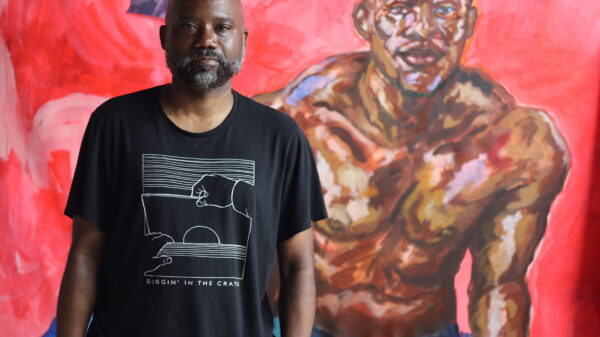
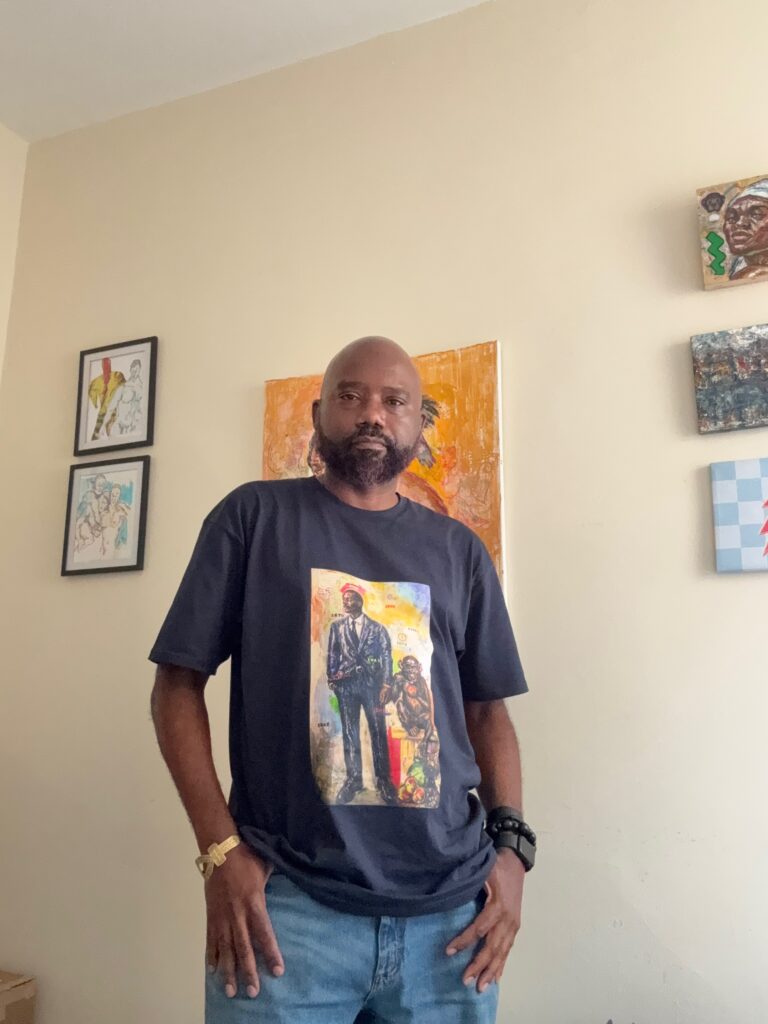
When Ricardo Osmondo Francis was in high school in Houston, an art teacher told his class on a museum trip that most people spend 2.5 seconds looking at a work of art before moving to the next one. Francis decided he never wanted that to happen to his work.
Years later, at The Black Iconic, his 2023 solo exhibition at Yonkers Public Library, some visitors stayed in the gallery for more than an hour. Some came back. Young people brought their friends. The curator, Haifa Bint-Kadi, told him what she kept hearing from them: they finally felt seen as people.
That response is the idea behind APANAMAE Productions, the nonprofit Francis founded to educate the public, represent underrepresented voices, and bring art closer to people who rarely see themselves in galleries and museums. His father is from Colón, Panama, and the organization’s name carries that: Panama, with an A added at the front and an E at the end. APANAMAE received its 501(c)(3) designation in May 2026.
I spoke with Francis about the organization’s mission, the impact he hopes to have, the programming he wants to develop, and what $50,000 could make possible.
What is APANAMAE Productions’ mission, and how does it help the community?
Our mission is essentially to educate the public and to represent underrepresented voices, groups in society that are oftentimes overlooked, misunderstood, or categorized negatively and unduly. And it’s to have a real conversation about humanity.
Even when some of the work is very social or political, I prefer to take a more open-minded approach. There’s so much information in the work visually, and people can explore it. It’s not pointing at them and saying you have to believe in X, Y, and Z. It’s more of an inner conversation.
I would prefer someone to continue to come back. I want them to have a deep connection to what they’re seeing. That’s why layering is really important in the work. If you’re going to have a real conversation artistically, that conversation has to be multifaceted.
I really want the work to be as close to the public as possible. The visual arts are always in art galleries and museums, and although those places are great, they don’t reach as many people as they should. Even in New York, there are many communities of color where people have not been to the Metropolitan Museum of Art or to MoMA. These are world-class museums. They all have family days and tours, and there’s still a disconnect.
A lot of it’s cultural. I hate to say this, but it gets seen as a white people thing, a rich people’s thing, something for the artsy types.
I don’t want any of that to be part of the equation for APANAMAE Productions. It’s a place for everyone. Whether it’s a solo show, a group show, a workshop with students, or a collaboration with other artists, all of our projects are meant to enlighten and educate at the same time.
What impact has APANAMAE Productions had, and what has informed its development?
This is APANAMAE’s second phase. It was around for about five or six years, 2000 to 2006, and at that time I was just winging it. It wasn’t a nonprofit structure. It wasn’t much of a structure at all. It was, let me hustle. I knew how to find spaces to show my work, how to network and get people interested in doing stuff.
That period propelled me for most of my career in terms of how I developed my work. The collaging process started around then.
I met my mentor in early 2006. It was a sort of life version of grad school. He rewired my brain in terms of how I approached my work. He helped me learn how to draw and paint, how to see, and how to trust myself a lot more. He passed away in 2021. He was practically like a father to me.
APANAMAE was always in the back of my head. I felt like I needed to do it but wasn’t sure if I could. Last year it came like a call. It kept repeating in my head: it’s time.
I asked my friend Nora whether I should make it a for-profit or a nonprofit, and she let me make the decision on my own. I’ve worked for quite a few nonprofits in my life, and I like that most of them are about helping others. I want to do that.
I kept hearing the same thing about The Black Iconic. The curator told me, and then a fellow artist who went to document the show said it too: people would stay there for a long time.
I don’t have control over how people view my work. But when an artist submits to the work and allows it to guide them, the conversation the work has with the audience is quite profound.
I want this to be something that is all the time. I don’t want to do a show every so often and then disappear. I want APANAMAE to be a constant, something that’s always present.
I realized how important art is during COVID and the Black Lives Matter movement. Visual art was one of the first beacons of light people had. Artists were responding to what was happening, and they wanted to show a way out or uplift the public. We needed that.
I think if artists are never around to remind people of their humanity, then humanity is doomed.
What opportunities do you want to create for young people and emerging artists?
I definitely want to do workshops. They’re fun to do. I don’t want to be a professor or anything, but I believe in doing workshops with young artists and with students in general.
It’s one thing to conjure up what’s inside someone through words. To have people express themselves through drawing, through painting, there are even deeper things there that were lying dormant for a long time.
Even if it’s just once, for someone to be in a setting away from their normal existence, to escape for an hour or two with others doing the same thing, that may evoke an idea and inspire them to continue with something they thought they could not do.
I also want APANAMAE to be an organization that champions education, even if it’s not in the arts. One of the things I’ve always struggled with is seeing how this country denounces education.
When I visited Spain many moons ago, almost everybody was at the museums: young people, old people, people in middle age. Going to a museum is integrated into their society. Here in the U.S., it is very specific groups of people who are typically there.
One of the most beautiful shows I’d seen in a long time was the Harlem Renaissance show at the Metropolitan Museum. To see that work, and to see so many Black men, women, and children there to witness it, was reassuring. We will be seen, and we are being seen. I want to make sure APANAMAE is an integral part of that process.
What is currently preventing APANAMAE Productions from realizing its vision?
A lot of it is waiting on funding. That’s the main thing.
I had cemented a major solo show that was going to be a physical introduction of the organization to the public. It was going to happen in early September, and with the curator we had already set up the events connected to the project.
Some of the funding we expected didn’t come through, and we were still waiting on other grants.
My spirit was telling me, you need to postpone the show. So I told Nora I want to postpone until the funding is definitely there at our disposal. I do not want this to be a last-ditch effort. I was doing last-ditch efforts with APANAMAE twenty years ago, and that’s kind of exciting as a twenty-something.
I’m learning the process of development, and one of the many aggravations of doing this is the waiting. I’m already a very impatient person. But these are learning curves too.
This started as a series of conversations in November of last year, and we already are a 501(c)(3). If that’s not meant to be, I don’t know what is.
I’ll be honest, I’m the happiest I’ve been in a very long time. I think it’s because APANAMAE is here.
If someone invested $50,000 in APANAMAE Productions tomorrow, what would you do with it?
I would want a small staff to start. I would want to be in a brick and mortar with my studio, office space for staff, and a small gallery for working with other artists and showing their work, and for things like poetry jams and small performances.
I would love to have that because I grew up around it back home. There was the Midtown Arts Center and the Community Artists Collective. My first studio, which I shared with classmates from the High School for the Performing and Visual Arts, was at Midtown Arts Center, and two blocks over was the Community Artists Collective.
I want to be a small but strong artist hub. That’s what I would do with 50K.
Yes, pay me. Yes, I want to pay my staff. But the biggest incentive is making sure the public has access to artists’ work, especially artists of color.
The Importance of Creating
There is something I want to add about Ricardo that goes beyond the work he is doing through APANAMAE Productions.
An interview about mission and programming can only hold so much of him. Ricardo embodies what he speaks about. You see the sophistication in his art, and you hear it in how he speaks, listens, and brings people and ideas together. Even in casual conversation he chooses his words with care. It is beautiful to witness.
That matters, because the organization he envisions can do something meaningful for artists who lack access to the spaces, relationships, and resources it takes to share their work.
We underestimate how many talented artists never get to exhibit what they’ve made. Making the work is one challenge. Finding the right space, building relationships with galleries, getting in front of the right people, and navigating the exhibition process is another one entirely. There are extraordinary pieces we will never see because the artist never had the opening, the connections, or the money to bring them before an audience.
Ricardo wants to change that. The artist hub he describes is an environment where artists feel safe, supported, and encouraged to create; where their work is presented and appreciated; and where programming brings people from different backgrounds together. He understands that access starts long before artwork goes on a wall. It means creating the conditions for artists to develop, participate, and be seen.
When James Rashad and I talk, we usually end up on the possibilities within New Jersey. And James always reminds me that this is bigger than New Jersey. The same holds for Ricardo. His vision reaches past any one state or community, toward a place where the chance to make, experience, and share art travels beyond geography.
Ricardo told me that if artists are never around to remind people of their humanity, humanity is doomed. I feel that urgency. There is a state of emergency when it comes to spaces where people can create, and we need places that encourage expression, protect artistic freedom, and bring people together.
I believe art is one of the few places where we can encounter truth without anyone explaining it to us. That feels especially important now, when people are showing a renewed appreciation for human connection, for things made by hand, and for experiences that feel real.
Ricardo understands that, and he wants to build the kind of space where other people can experience it too.
What’s Next for APANAMAE Productions
APANAMAE Productions is a Newark-based nonprofit bringing artists and communities together through exhibitions and public programs. Its work creates space for people to connect through art, conversation, and shared experiences.
- In Good Company: The Village We Build: A winter exhibition on Thursday, December 10, 2026, from 6 to 9 PM at Cova | coffee bar & gallery, 140 Halsey St in Newark. Presented by APANAMAE Productions and Cova, it honors the people, places, and memories that hold us and greets 2027 with jazz and poetry by local talent. Featured artists include Tasha Branham, Maria Luiz Estrela, Ricardo Osmondo Francis, Leandro Comrie, Reinaldo Perez Giraldi, Seth Ruggles Hiler, Jay Neyland, Mansa K. Mussa, CJ Priester, and David Oquendo. APANAMAE expects 75–100 guests and is seeking an in-kind contribution of wine for the reception.
- An artist hub: A physical home with a studio, staff offices, and a small gallery for other artists’ work.
- Workshops: Programming for young artists and students.
- An immigration project: A major group project on immigration, a subject Francis says he has always wanted to take on.
- Panama City: A major solo project in Panama City, Panama, a show he has wanted to do for more than a decade.
- A working board: Francis tells every board member the organization is a democracy. He calls the process “an intellectual jam session.”
How to Support APANAMAE Productions
Make a Donation: Fund the Work
Contributions support exhibitions, educational programming, artist opportunities, and the organization’s development. Give at https://www.apanamae.com/donate.
Become a Partner
APANAMAE Productions is looking for galleries, museums, cultural institutions, and funders interested in presenting diverse artistic perspectives. Visual and performing artists who want to take part in exhibitions, performances, and community programming are welcome too. Connect through https://www.apanamae.com.
Host a Workshop
Schools and community organizations can bring arts workshops and programming to their students. Reach out through https://www.apanamae.com.