



How Detroit native made the harp swing, and why her sound still echoes in our hearts.
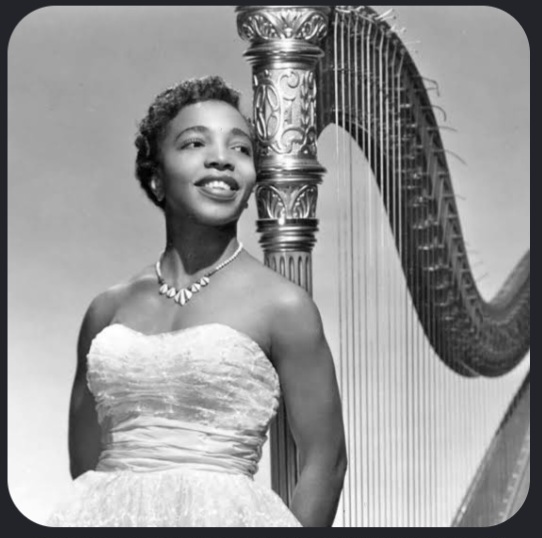
Most people associate the harp with classical orchestras and elegant concert halls. Few realize that one extraordinary musician transformed the instrument into a powerful voice in modern jazz. That visionary was Dorothy Ashby, a gifted jazz harpist, composer, and singer whose creativity forever changed the way musicians viewed the harp.
Throughout American music history, countless Black musicians have made remarkable contributions without receiving the recognition they deserved. These hidden figures helped shape jazz, rhythm and blues, rock and roll, gospel, and hip-hop while overcoming racism and limited opportunities. One such pioneer was Dorothy Ashby.
From Detroit With Love
Born Dorothy Jeanne Thompson on August 6, 1932, in Detroit, Michigan, Ashby grew up in a household filled with music. Her father, Wiley Thompson, was a self-taught guitarist who introduced her to both the piano and guitar. Raised within Detroit’s vibrant jazz community, Dorothy developed an appreciation for music at an early age.
She later attended Cass Technical High School, renowned for its outstanding music program. There, she studied saxophone and string bass before developing a passion for the harp. Influenced by the strict classical techniques of celebrated French harpist Carlos Salzedo, Ashby built a strong technical foundation that would later allow her to redefine the instrument’s role in jazz.
After graduating from high school, Ashby enrolled at Wayne State University, where she studied vocal technique, piano, and harp while performing with the student orchestra. Upon graduation, she settled on the harp as her primary instrument in 1952 and soon made her professional debut as a jazz harpist in a Philadelphia nightclub.
Breaking Into Jazz
At a time when the harp was considered an orchestral instrument reserved almost exclusively for classical music, Ashby challenged convention. She believed the harp belonged in jazz alongside the piano, saxophone, and trumpet. Although many jazz musicians initially resisted the idea, she persevered by organizing free performances and playing dances, weddings, and community events with her trio. Her determination gradually earned the respect of audiences and fellow musicians alike.
“It’s been maybe a triple burden in that not a lot of women are becoming known as jazz players … The audiences I was trying to reach were not interested in the harp, period — classical or otherwise — and they were certainly not interested in seeing a Black woman playing the harp.”
W. Royal Stokes interview for his book “Living the Jazz Life,” 1983
— Dorothy Ashby,
On March 21, 1957, Ashby released her debut album, “The Jazz Harpist,” on Regent Records. Widely recognized as the first jazz album to establish the harp as a serious bebop instrument, the recording received critical acclaim, although it was largely overlooked by the general public.
A Sound Of Her Own
Over her career, Ashby recorded eleven albums as a bandleader for Atlantic, Cadet, and other record labels. Fearless in her artistic vision, she blended bebop with soul, Brazilian, African, and Middle Eastern musical influences, creating a sound that was uniquely her own.
One of my personal favorite recordings by Dorothy Ashby is “Come Live With Me.” It beautifully showcases her ability to combine technical brilliance with warmth, emotion, and musical sophistication.
Beyond performing and recording, Ashby was committed to uplifting her community. During the 1960s, she and her husband established a theatrical group that produced plays for Detroit’s African American community. She also hosted her own radio program and, in 1962, was honored as an All-Star Jazz Performer by DownBeat magazine.
The Sound That Outlived Her
Throughout the 1970s and 1980s, Ashby collaborated with acclaimed artists including Bill Withers, Bobbi Humphrey, Bobby Womack, and Stevie Wonder. Her innovative approach would later influence generations of hip-hop producers and artists. Musicians such as Pete Rock, J Dilla, and Jay-Z sampled her recordings, introducing her artistry to entirely new audiences.
Dorothy Ashby passed away on April 13, 1986, at the age of 53 after battling cancer. Although she did not always receive the recognition she deserved during her lifetime, her creativity, innovation, and perseverance continue to inspire musicians around the world.
As we celebrate 250 years of Black voices in America, Dorothy Ashby’s story reminds us that history is often shaped by visionaries whose names deserve to be remembered alongside their more celebrated peers. Her legacy lives on every time a musician dares to challenge tradition, expand the possibilities of an instrument, and create something the world has never heard before.
P.S. Dorothy Ashby would have turned 94 this week — born Aug. 6, 1932. Happy belated birthday to the woman who made the harp swing. Celebrate her by listening to the 1968 classic Afro-Harping by Dorothy Ashby.