












New Jersey’s first HIV service provider heads into its Nov. 7 fundraiser with a list of clients lost this year and an original painting on the auction block.
New Jersey’s HIV numbers are moving in the right direction. Nearly 90% of residents in HIV care reached viral suppression in 2024, according to the state Department of Health. The weight still falls hardest on Black New Jerseyans, who made up 15% of the state’s population in 2020 and 44% of the people living with the virus, and on Essex County, home to Newark, which had the highest prevalence rate in the state.
Falling numbers don’t ease the pain of losing someone close to you. Before we spoke this month, Montrese Millhouse went over a list with her staff: the names of Hyacinth clients who died in 2026, some from HIV-related causes, a few from overdoses.
Millhouse has been with Hyacinth AIDS Foundation for close to 11 years and manages harm reduction for its Jersey City office. She brought the list up while we were talking about the gala.
“It’s just very … sad to think that in 2026 with so many medical marvels that there are still people passing away from HIV,” she said.
The services exist. Reaching them is the problem, she said, for clients forced to choose between a shelter bed and a trip to the syringe exchange.
The doors opened for Hyacinth 1985 in New Brunswick, in the earliest years of the epidemic, as New Jersey’s first HIV service provider.
It now runs eight offices across the state, including Newark, Jersey City, Paterson and Trenton, and the work long ago spread past testing and treatment. Millhouse ran down the menu: syringe access, low-threshold buprenorphine for opioid use with no insurance required, drop-in centers and showers at some sites, help replacing an ID or birth certificate, and rental assistance for clients living with HIV.
Hyacinth’s revenue rose from about $9.7 million in the fiscal year ending June 2022 to $15.4 million in fiscal 2025, a 59% jump, according to its federal tax filings. More than 80% of that money came from government grants in 2024, according to nonprofit data firm Impala, and grants come with conditions. Rocio Ruiz, the organization’s Director of Prevention, laid out the problem in written responses to my questions.
“Those grants often come with very specific restrictions on how the money can be spent,” Ruiz wrote. “Unfortunately, the needs of the people we serve don’t always fit neatly within those funding guidelines.”
Ruiz described the uninsured client who needs extra lab work, the person who wants PrEP and can’t cover the associated costs, the person who comes in for an HIV test and hasn’t eaten that day.
“It’s difficult to ask someone to prioritize their healthcare when they’re worried about where their next meal is coming from or where they’re going to sleep that night,” she wrote.
‘Where is social services going to be sending that mail?’
When I asked Millhouse why an HIV organization puts so much into housing, she answered with a chain of events. Life on the street brings trauma, which can lead to substance use, or to sex work traded for a meal or a warm place in winter. Risk climbs from there, and without an address, the exits close.
“If an individual does not have an address, they can’t even apply for social services, because where is social services going to be sending that mail?” she said.
Shelters run over capacity. Millhouse described clients who spend the night sitting in a chair “for 10 to 12 hours” and shelters with two or three washing machines for everyone. She also rejected the idea that the people who walk through Hyacinth’s doors built their own crisis.
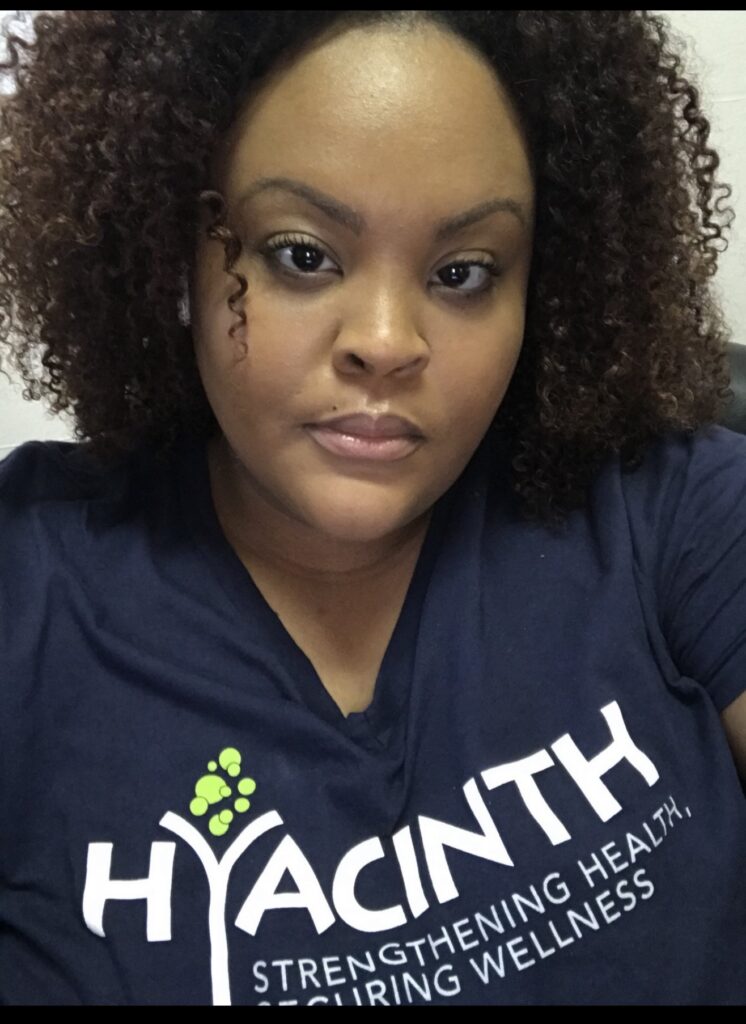
“It’s systemic. It’s something that any person can experience,” she said, adding that many clients once held high-powered jobs or finished college.
Federal cuts would make it worse. Millhouse walked through it: lose rental assistance, lose the apartment, fall off the regimen.
“A very basic necessity such as healthcare, which shouldn’t even be on the table for cuts, period, if you ask me,” she said.
When Millhouse meets someone at a bus stop who seems open to it, she offers a flyer and an invitation to a community event, with no pressure to enroll. She also tells them where she has been.
“I once was too a person who accessed social services, and I know how difficult that is, navigating those services,” she said.
She does not make sobriety the price of help.
“Wherever you’re at at that moment is where I’m at,” she said.
Her colleague Ricardo Francis came to the work through housing. In just over three years at Hyacinth, he has worked in its Jersey City and West New York offices, where clients living with HIV often had to choose between antiretroviral medication and rent. Many picked rent and went without their medication for months, he said. Today he works with Project Living Out Loud, the organization’s LGBTQ prevention program in Hudson County. Under a CDC grant, he interviews people for an ad campaign: people living with HIV, people who are HIV negative and share how they stay that way, and people in recovery from substance use.
“There’s always a box of Kleenex next to me when I’m interviewing people,” he said.
He also took on the grant itself. Its original scope was hesitant about testing women, which Francis called “crazy.” He kept pushing until Ruiz rewrote it to reach more women. His goal is testing for everyone, regardless of gender or sexuality.
Ruiz learned persistence from Deloris Dockrey. Born in Jamaica and living with HIV since 1994, Dockrey spent 15 years at Hyacinth, became the first woman to chair the Global Network of People Living with HIV/AIDS and died of COVID-19 complications in April 2020. Hyacinth’s community advocate award carries her name. Ruiz, who called Dockrey a mentor, wrote that the lesson outlived her.
“Deloris taught me that leadership is not about having the loudest voice in the room,” Ruiz wrote. “It’s about making sure the voices of the people who are too often unheard are never forgotten.”
‘Figuring out what the painting wants’
Francis is also a painter, known mostly for portraits. When Hyacinth’s development office asked him to donate a piece from his existing portfolio for this year’s silent auction, he turned down the easy route.
“I told her right away … I want to do an original painting,” he said.
He built it around Hyacinth’s 40 years of prevention and care, and he chose abstraction on purpose. A portrait puts a specific face on a collector’s wall, and he said people “can be leery” of that. Symbols and nostalgic imagery that viewers already recognize gave him another way into community and resilience. Then he let the process lead.
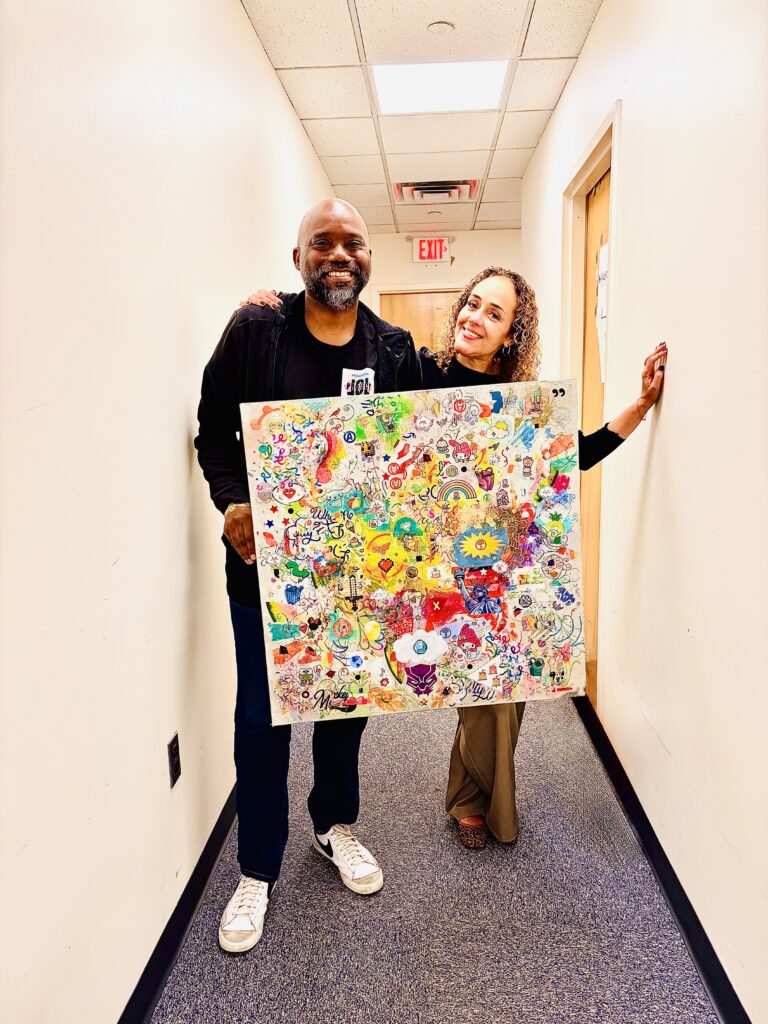
| Acrylic and Mixed-Media Collage
“I love juxtaposition, because in the process of doing it, the layers and the meaning makes more sense,” Francis said, “just by … going through the process and figuring out what the painting wants.”
The finished work, “(HERE) to Live Our Lives, (HERE) to Protect Our Own,” is a 30-by-30-inch acrylic and mixed-media collage. He said the title sums up Hyacinth “in a nutshell.”
I went to an arts high school in Newark, where mosaics were my favorite medium, and Francis’s canvas took me back there. The first time I saw it, I stood and stared while my eye traveled through it in a spiral.
I asked whether working at a people-first organization had changed his art. He took his time.
“I’m going to say yes. However, I’m not sure how,” he said. “It’s not a cryptic answer, I promise you.”
He settled on a partial answer.
“The work is definitely about people. But my day job is definitely about people,” he said. “They kind of, I would say, work in tandem with each other.”
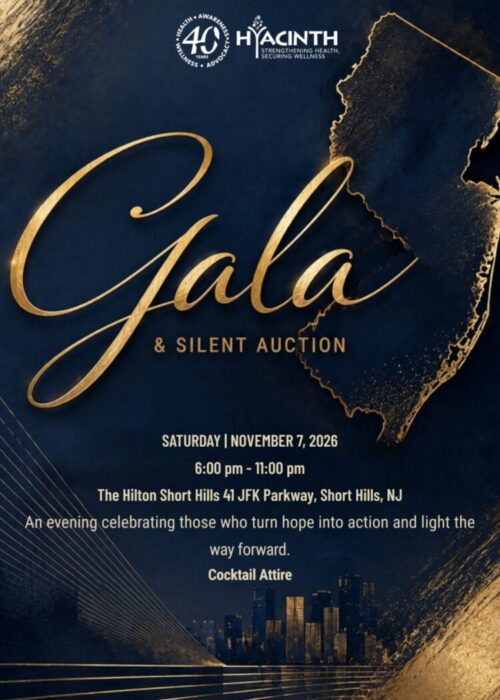
The 41st Hyacinth Gala and Silent Auction is Saturday, Nov. 7, at the Hilton in Short Hills, NJ. The silent auction is open now, and Francis’s painting is in it. Millhouse expects this year’s proceeds to cover client services grants won’t pay for, and to keep programs running if federal money gets cut.
A ticket is one route. Francis pointed to other ways to support Hyacinth.
“The whole point of this is to give,” he said.
Donate if you can’t attend, or volunteer at one of Hyacinth’s eight sites. Millhouse’s Jersey City office takes volunteers and accepts clothing and unexpired canned goods for its pantry. Local businesses can sponsor the night or donate auction items through https://www.hyacinth.org/donate/.
Ruiz had a message for the reader who has never been to a gala and assumes it isn’t for them.
“You don’t have to work in healthcare, know someone living with HIV, or have a personal connection to Hyacinth to be part of this evening,” she wrote.
She wants first-time guests to leave saying, “I didn’t realize how much Hyacinth does for the community, and now I want to be part of that work.”